
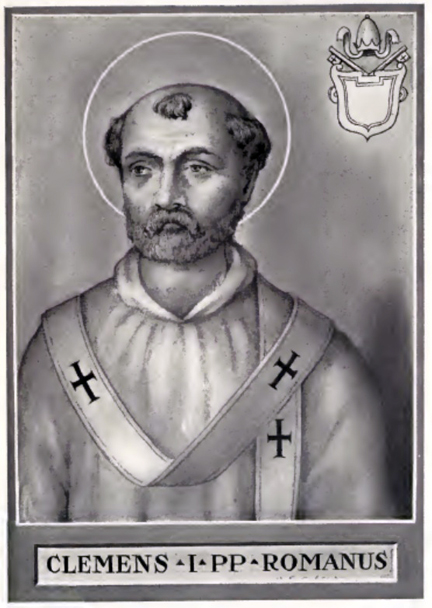
Modern evangelicals find themselves, for the most part, unaware of their forefathers in the faith and the literary works which they have left for us. It was not until the last few years that I have taken the study of the history of the Church seriously, and not until very recently that I decided to spend some time examining those ancient Christians and their literature, which we call the “Apostolic Fathers”. In the first of these works, the letter of 1 Clement, is a wonderful prayer which is found near the end of the lengthy letter.
Clement is one of the first identifiable Christian writer/theologians outside of those who wrote the New Testament. The letter of Clement to the church at Corinth is traditionally dated in the late 90’s AD. He was a contemporary of the Apostles, very likely referred to by Paul in Philippians 4:3. Clement stood as a leader of the Church in Rome and his only authentic letter which survives to the present day is 1 Clement, although a number of spurious works were later produced and falsely assigned to him.
I believe that we can learn a great deal about our faith from Clement. His theological insights provide a glimpse into the teachings of the earliest churches. His address to the Corinthian church (the recipient of his letter) gives a glimpse into the early struggles of churches outside of Rome and gives occasion for understanding how such issues were addressed by early Christian leaders. As I read the letter, I was particularly struck by the prayer contained in Chapters 59:3-61:3. I will append the text of that prayer to the end of this post.
I would propose that this prayer has enduring usefulness for the church today, not only for its literary loftiness and theological soundness, but as a model for the prayer of God’s people almost 2000 years after it was originally written. One’s prayer life should not be relegated to the prayers of those who came before them and especially should not be a simple recitation of them. Nonetheless, it is useful to identify patterns in the prayers of others which may be employed in our own prayer. This model below, therefore, is not an invitation to recite Clement’s prayer nor am I suggesting it is the only or best model for prayer. What follows is not a detailed analysis of the prayer, but a cursory overview of it in search for a general model. I hope it may be used with profit by the church of the living God.
I. Adoration
The prayer begins where all meaningful worship, including prayer, begins- with adoration and praise for the God of Israel, to whom we pray. There are specific ways in which Clement expresses his adoration of God. He addresses him as the creator of the world, “our hope resting on Thy name which is primal cause of every creature”, the operator of regeneration, “having opened the eyes of our heart to the knowledge of Thee”, and the holy and righteous Omnipotent, “who alone ‘dost rest highest among the highest, holy among the holy,’ who ‘layest low the insolence of the haughty,’ who ‘destroyest the calculations of the heathen,’ who ‘settest the low on high and bringest low the exalted;’ who ‘makest rich and makest poor,’ who ‘killest and makest to live’.
II. Petition for the Church
Clement’s prayer continues with a petition for the provision and safeguard of the church. The most striking feature of this section is that Clement’s prayer abounds with familiar themes of contemporary prayer: deliverance of the persecuted, healing of the sick, comfort for the grieving, etc. The goal, however, of this petition is not that these things should be an end in themselves, but that through them God should be greatly glorified. So prays Clement, “let all the nations know that Thou art God alone and Jesus Christ Thy Son, and we are Thy people and the sheep of Thy pasture.”
III. Confession and Petition for Forgiveness of Transgression
This prayer displays a sound judgment of man’s sinfulness and dependence toward God, who is a righteous judge. After appealing to God’s power, justice, wisdom, and mercy, Clement prayed, “O merciful and Compassionate One, forgive us our iniquities and offenses and transgressions and trespasses.” The aim of this confession is true, in that it is not only for a cleansing of the conscience, but for a restoration of the church to live holy lives as the redeemed people of God. Thus prays Clement, “direct our steps that we may walk in holiness of heart and do what is good and well-pleasing in Thy sight”.
IV. Intercession for Leaders
There is a contextually significant portion of the prayer which deals with prayer for the Roman leaders, highly antagonistic and persecuting toward the Christians of Clement’s time. “To our rulers and governors on the earth — to them Thou, Lord, gavest the power of the kingdom by Thy glorious and ineffable might, to the end that we may know the glory and honor given to them by Thee and be subject to them, in nought resisting Thy will; to them, Lord, give health, peace, concord, stability, that they may exercise the authority given to them without offense.” Clement recognized that all authorities on the earth rise and fall at the beckoning of Heaven’s King and prayed earnestly for them to preside as wise, stable rulers. What a convicting reminder of our responsibility as Christians in a turbulent political climate of our own!
V. Adoration
Adoration of God bookends this prayer, as it should all prayer. “O Thou, who only hast power to do these things and more abundant good with us, we praise Thee through the High Priest and Guardian of our souls Jesus Christ, through whom be glory and majesty to Thee both now and from generation to generation and for evermore. Amen.”
Concluding Reflections
As promised, this is not a thorough treatment of Clement’s prayer, contained in his letter to the Church at Corinth. The text is widely available and one may study it at their leisure. What I hope that this can provide is just one of many helpful models of prayer left to the church of our time from men of the faith who lived long ago. At times it is convicting to see the Scripturally rich, thoughtful prayers of others when we evaluate our own prayers in their light. On the other hand, it is enormously encouraging to find that the essential nature and features of prayer have gone unchanged throughout the nearly two millenia of Christian history. Engaging with God by affirming his attributes, calling on him to heal, to save, to deliver, confessing our sins in light of his righteousness, praying for those who have temporary, vanishing authority on the earth and proclaiming our salvation through our High Priest and Guardian is a timeless, appropriate way to approach our God, whom we love and strive to glorify.
For a more robust treatment of a method for prayer, check out this website. It is a tremendous exercise in learning to pray God’s Word.
For your reading pleasure, the text of 1 Clement 59:3-61:3, accessed through Bibleworks software. This is the translation performed by Alexander Roberts and James Donaldson, originally published in 1885:
— having opened the eyes of our heart to the knowledge of Thee, who alone “dost rest highest among the highest, holy among the holy,” who “layest low the insolence of the haughty,” who “destroyest the calculations of the heathen,” who “settest the low on high and bringest low the exalted;” who “makest rich and makest poor,” who “killest and makest to live,” only Benefactor of spirits and God of all flesh, who beholdest the depths, the eye-witness of human works, the help of those in danger, the Savior of those in despair, the Creator and Guardian of every spirit, who multipliest nations upon earth, and from all madest choice of those who love Thee through Jesus Christ, Thy beloved Son, through whom Thou didst instruct, sanctify, honor us. We would have Thee, Lord, to prove our help and succor. Those of us in affliction save, on the lowly take pity; the fallen raise; upon those in need arise; the sick heal; the wandering ones of Thy people turn; fill the hungry; redeem those of us in bonds; raise up those that are weak; comfort the faint-hearted; let all the nations know that Thou art God alone and Jesus Christ Thy Son, and we are Thy people and the sheep of Thy pasture.
Thou didst make to appear the enduring fabric of the world by the works of Thy hand; Thou, Lord, didst create the earth on which we dwell, — Thou, who art faithful in all generations, just in judgments, wonderful in strength and majesty, with wisdom creating and with understanding fixing the things which were made, who art good among them that are being saved and faithful among them whose trust is in Thee; O merciful and Compassionate One, forgive us our iniquities and offenses and transgressions and trespasses. Reckon not every sin of Thy servants and handmaids, but Thou wilt purify us with the purification of Thy truth; and direct our steps that we may walk in holiness of heart and do what is good and well-pleasing in Thy sight and in the sight of our rulers. Yea, Lord, make Thy face to shine upon us for good in peace, that we may be shielded by Thy mighty hand and delivered from every sin by Three uplifted arm, and deliver us from those who hate us wrongfully. Give concord and peace to us and all who dwell upon the earth, even as Thou gavest to our fathers, when they called upon Thee in faith and truth, submissive as we are to Thine almighty and all-excellent Name. To our rulers and governors on the earth — to them Thou, Lord, gavest the power of the kingdom by Thy glorious and ineffable might, to the end that we may know the glory and honor given to them by Thee and be subject to them, in nought resisting Thy will; to them, Lord, give health, peace, concord, stability, that they may exercise the authority given to them without offense. For Thou, O heavenly Lord and King eternal, givest to the sons of men glory and honor and power over the things that are on the earth; do Thou, Lord, direct their counsel according to that which is good and well-pleasing in Thy sight, that, devoutly in peace and meekness exercising the power given them by Thee, they may find Thee propitious. O Thou, who only hast power to do these things and more abundant good with us, we praise Thee through the High Priest and Guardian of our souls Jesus Christ, through whom be glory and majesty to Thee both now and from generation to generation and for evermore. Amen.
 Preston Kelso